On-boarding
Hello and welcome! This document is a collection of the steps to get setup in the lab, along with some useful tools and tasks that the lab is interested in. For a collection of How-to’s, see here. Lab reading background can be found here and publications here.
Getting started
What do we do?
Our work focuses on characterizing gene function and developing methods to understand gene function and dysfunction in disease.
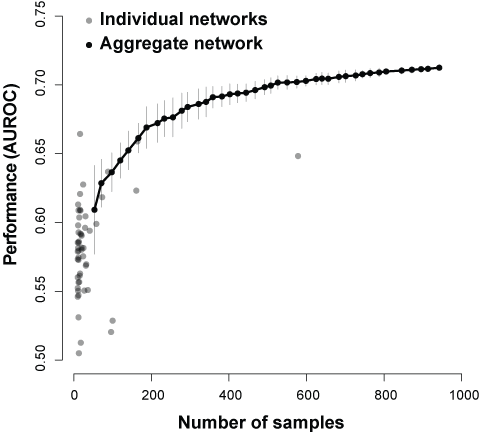
We particularly look to gene expression and co-expression networks derived from thousands of expression datasets and samples.
Functional genomics
An important focus (and challenge) in functional genomics is gene function prediction and assessment.
Guilt-by-association
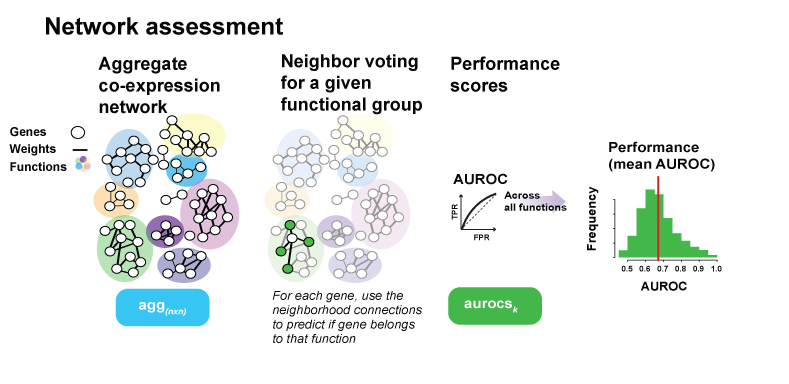
The guilt by association principle states that genes with similar functions will tend to possess similar properties. This allows previously unknown functions of a gene to be statistically inferred given some prior knowledge about other genes.
-
A set of candidate genes: All genes in the genome or a more focused set such as those in a candidate genetic locus.
-
One or more target gene groups of interest: Typically defined around a function, such as those from the Gene Ontology (GO).
-
Data with associations or similarities among the target and candidate genes: These data are often represented or thought of as a network, and can include coexpression, protein interactions, genetic interactions, sequence simlarities, phylogenetic profiles, and phenotype and disease association profiles.
-
An algorithm: This is to transfer (or infer) functional labels from the target genes to the previously unlabeled candidate genes.
Differential expression, co-expression and differential co-expression
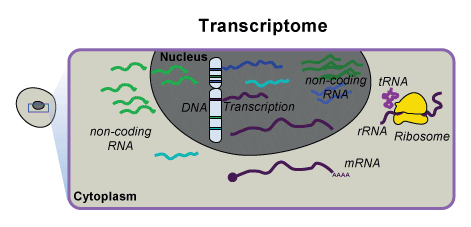
The transcriptome is all the RNA molecules expressed from the genes of an organism.
Generally, three approaches are taken to analyse transcriptional data which include differential expression, co-expression and differential co-expression.
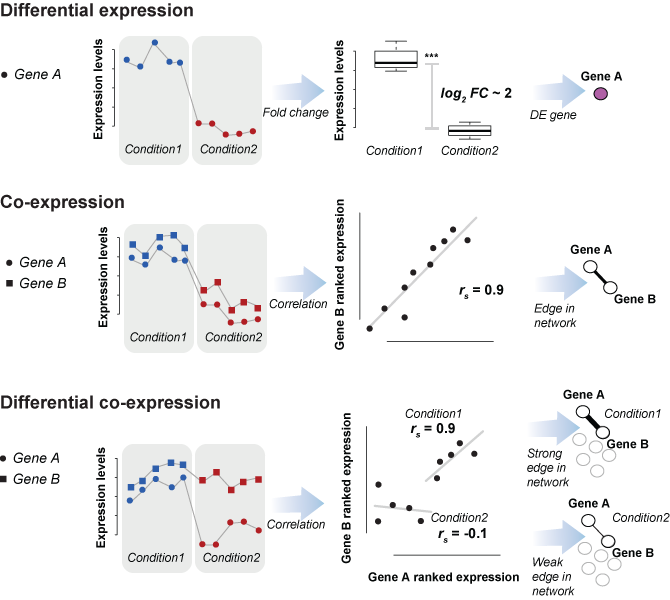
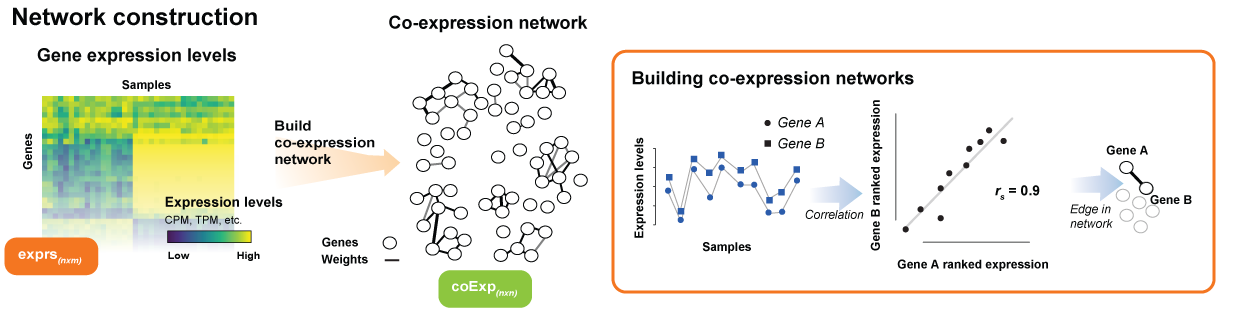
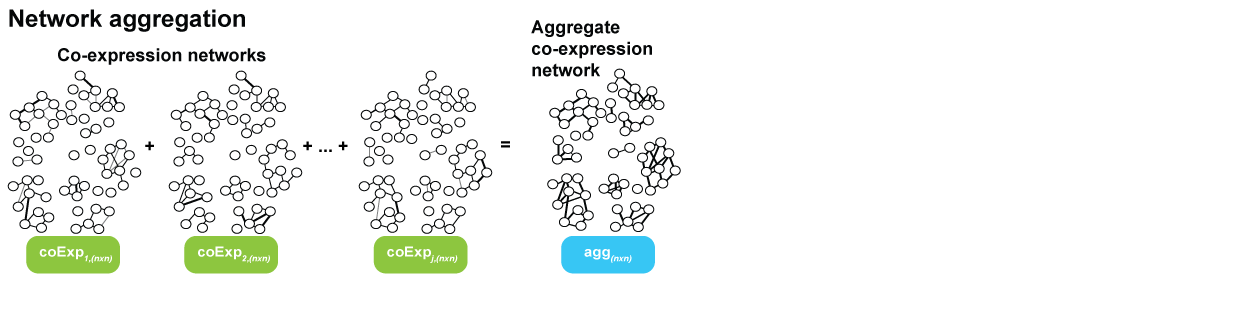
Co-expression is meant to reflect co-regulation, co-functionality and co-variation. We have shown the utility of co-expression, in particular meta-analytic co-expression, in a variety of applications.
Neighbor-voting
Multifunctionality
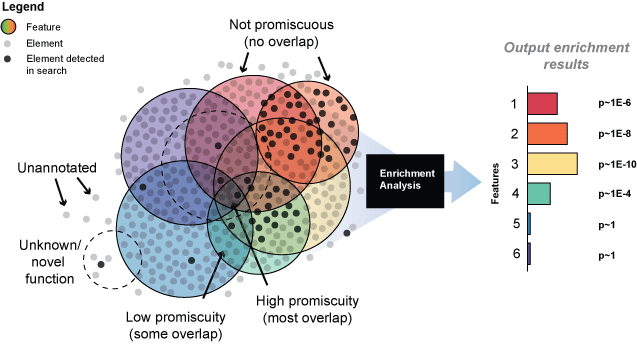
Gene multifunctionality is a pervasive bias in functional genomics. Prior work has focused on evaluating how this bias impacts the generation of biologically non-specific results as well as highly fragile significances in a variety of fields.
Tools and techniques
Microarray
Notes here
RNA-sequencing
Some useful notes here and here
Bulk
List of tools here And some others like fastX and fastQC are good for QC.
Single-cell
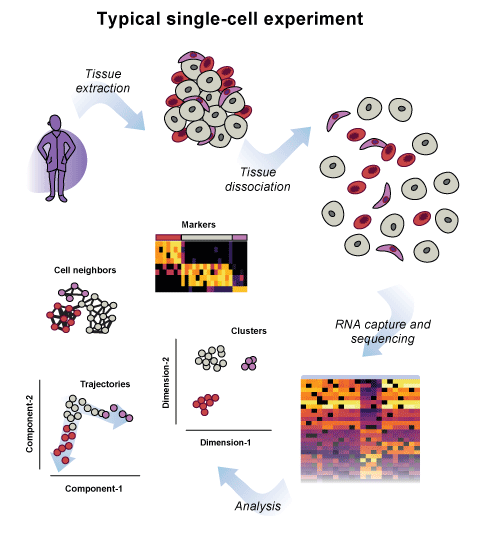
List of all tools here. Some key tools include Seurat and scanpy. Comprehensive tutorials like Hemberg lab’s course are particulary useful.
Alignment tools
https://sarbal.github.io/howdoI/workflows/howtos_alignment.html
STAR
Github here and manual. Reference here and here.
Kallisto
Github here and tutorial. Reference here.
Salmon
Github here and manual. Reference here. The single cell version (Alevin) can be found here and ref.
Bowtie2
Source and manual. References here, here and here.
Gene set enrichment tools
Genomic tools
GATK. Also see best practices workflows.
UCSC tools. This also hosts genomic data of interest (like cross species alignments).
Databases and repositories
Gene expression data
Databases
SRA and human metadata at metaSRA.
Processed expression data
Core datasets
Co-expression databases
Genomic data and annotations
ENSEMBL. Note, contains data on multiple species.
GENCODE, specifically human and mouse. But modENCODE (for fly and worm).
Other types of data (such as sequence, protein, gene IDs) can be accessed from NCBI refseq through their ftp.
Ontologies
Ontologies have vocabularies (term -> term) and annotation (gene -> term) relationships. Some useful and key ontologies:
Gene Ontology
Related work.
Human phenotype ontology (HPO)
Others (and data) can be found here at the Harmonizome. The OBO foundry has the standard vocabularies.
Pathways
Biocarta. The original site seems to be dead/down.
Protein data
HuRI (human reference or CCSB)
Variant data
TOPmed which can also be accessed here.
Gene score lists such as RVIS and pLI are derived from versions of the above.
Gene lists
Imprinted genes and here.
X-escapers and here.
House keeping genes from RNA-seq data here taken from this. Microarray data version here. Newer studies using single-cell data here and here.
Essential and non-essential gene lists.Haploinsufficiency
Brain lists include synaptic genes, FMRP, chromatin remodellers.
Model organisms
Orthology
Species of interest
- Mouse (Mus musculus, 10090) at JAX
- Yeast (Saccharomyces cerevisiae,4932) at yeastgenome or (Schizosaccharomyces pombe, 284812) at pombase
- Fly (Drosophila melanogaster,7227) at flybase
- Maize (Zea mays, 4577) at maizegdb, gramene, or at ensembl
- Arabidopsis (Arabidopsis thaliana, 3702) here or AtGDB
- Worm (Caenorhabditis elegans,6239) at wormbase
- Zebrafish (Danio rerio, 7955) at zfin
- Frog (Xenopus laevis, 8355) at xenbase
- Armadillo (Dasypus novemcinctus,9361) at here and ensembl.
- Naked mole rats (Heterocephalus glaber, 10181) at here